On this page
- In short
- Why this matters
- Where should a hospital record a payment?
- How is OPD billing software different from other hospital billing?
- How does a split payment work on one bill?
- What is a payment link for hospital bills?
- Why do bill and receipt numbers matter?
- How should a hospital refund process work?
- How does the dashboard help at the end of the day?
- What should you check before you buy?
- What are the limits of this approach?
- How to start
- One last thing
Good hospital billing software India hospitals can rely on records the payment inside the patient's visit. It also takes part cash, part card and part UPI on one bill, and it writes a refund as its own document. This article shows what a receptionist and an accountant should check before you buy.
We are Fordawn, a software company in Salem, Tamil Nadu. We build MediFlow, a hospital system with billing, receipts, payment links and refunds. Where this article describes MediFlow, it says so. The rest is buyer guidance that applies to any vendor.
In short
- Record each payment inside the patient's appointment, so the money and the visit are one record.
- Enter each payment method on a split bill separately, with its own reference, and issue one receipt that lists them.
- Record a refund as a new document against the visit, so the original receipt and a refund note both survive.
- Check that bills and receipts are separate numbered series, and that a correction is a new numbered document, not an edit.
Why this matters
A hospital front desk takes money all day, in several forms. A patient pays part in cash because the card machine is slow. A relative sends the rest by Unified Payments Interface (UPI) from another phone. At closing time, the cashier has to match the drawer to the screen.
When the payment sits in a separate billing system, someone must join it to the visit by hand. That is where a mismatch starts. It is also where a refund turns into an argument, because nobody can show quickly what was paid and when.
The questions below suit an owner, an administrator or an accountant at an outpatient department (OPD) or a small hospital. They do not replace your auditor's advice, and they do not cover in-patient billing.
Where should a hospital record a payment?
Record it inside the patient's appointment. When a receptionist enters the payment against the visit, the visit and the money become one record. Nobody has to search a second system to learn what the patient paid for.
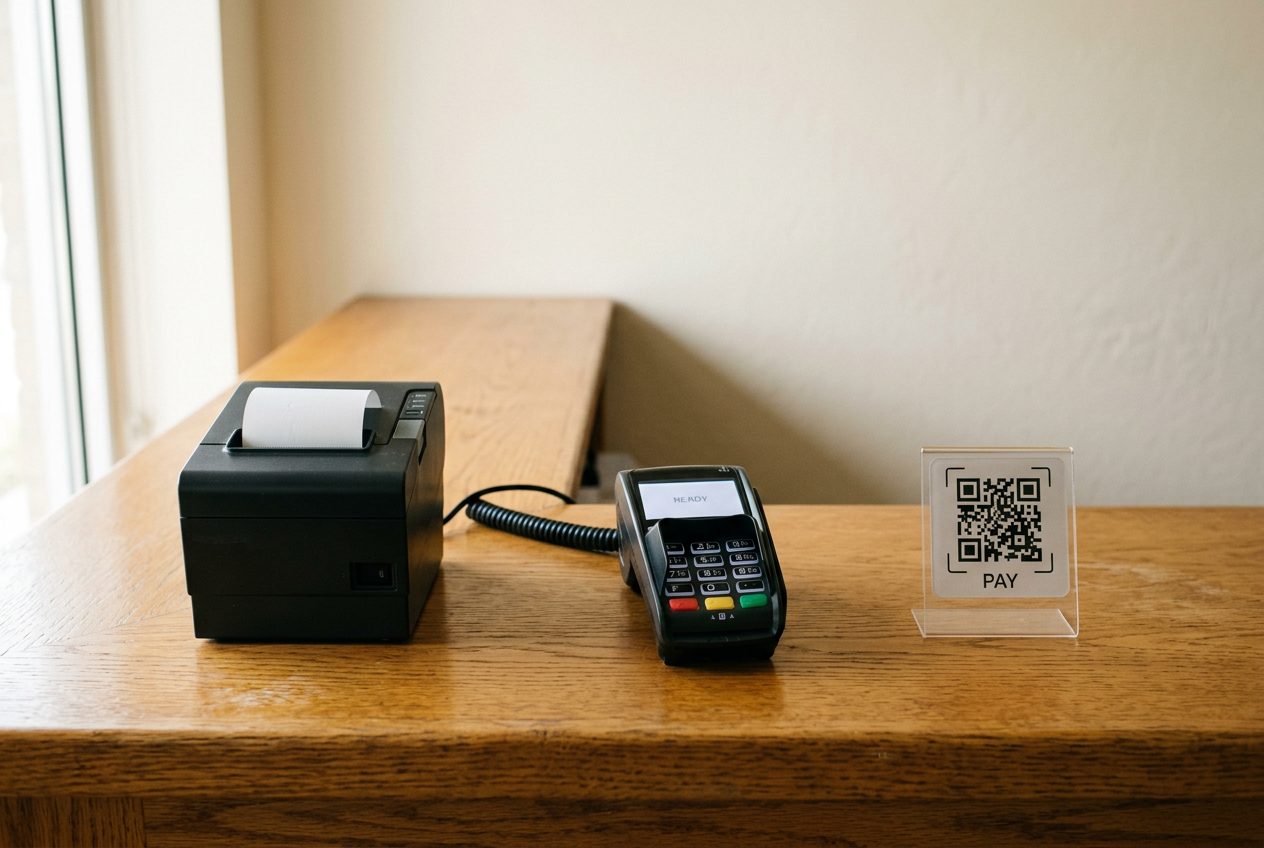
In MediFlow, a payment is recorded inside the appointment, not in a separate billing system. This suits a hospital that wants one record per visit. It suits a hospital less well if it needs billing kept in a different system for its own reasons. In that case, ask any vendor how the two systems would be matched each day.
You can see how the desk side works on our front desk page.
How is OPD billing software different from other hospital billing?
OPD billing software handles short visits with many small payments. A doctor's visit, a test and a medicine can fall on the same day for the same patient. It suits a hospital with a busy outpatient department, where the desk bills many people before lunch.
In-patient billing is a different job, with longer stays and running charges. This article does not cover it. When a vendor says "hospital billing", ask which of the two they mean, and ask to see that one on screen.
How does a split payment work on one bill?
One bill can take part cash, part card and part UPI. The receptionist enters each method separately, with its own reference. A card payment carries the card slip reference. A UPI payment carries the UPI reference. The balance updates as each method is added, and one receipt lists them all.
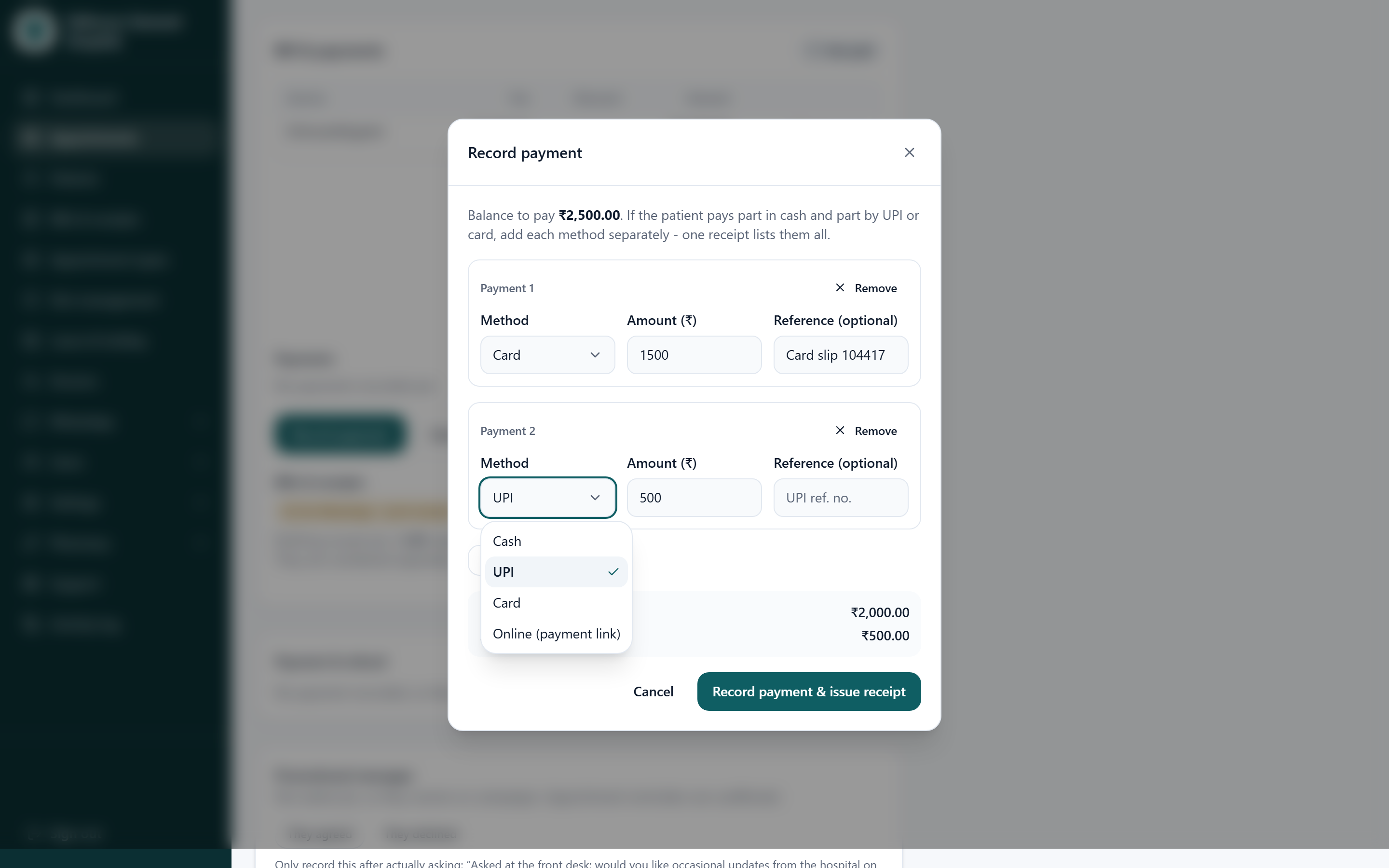
In MediFlow, the method list includes cash, UPI, card and an online payment link. A split bill suits the common case where a family pays in two or three ways. It also suits a desk that is busy, because the receptionist does not have to open a second screen.
The limit is the person typing. A reference is only as good as the number entered. Ask the desk to read the reference from the card slip or the UPI screen, not to guess it.
What is a payment link for hospital bills?
A payment link is a way to pay a bill online, without standing at the counter. It suits a patient who booked by phone, or one who has already left the building. It does not suit a patient who prefers to pay cash at the desk, and that option should stay open.
In MediFlow, UPI payments can be collected at booking or after the visit. The invoice is delivered into the same WhatsApp chat as the booking, so the patient finds the bill where the appointment already is.
There are two limits. First, payment collection depends on your hospital's own payment arrangements, so ask your bank or payment provider what they support. Second, Fordawn does not hold your hospital's money. The money moves between the patient and your hospital.
Why do bill and receipt numbers matter?
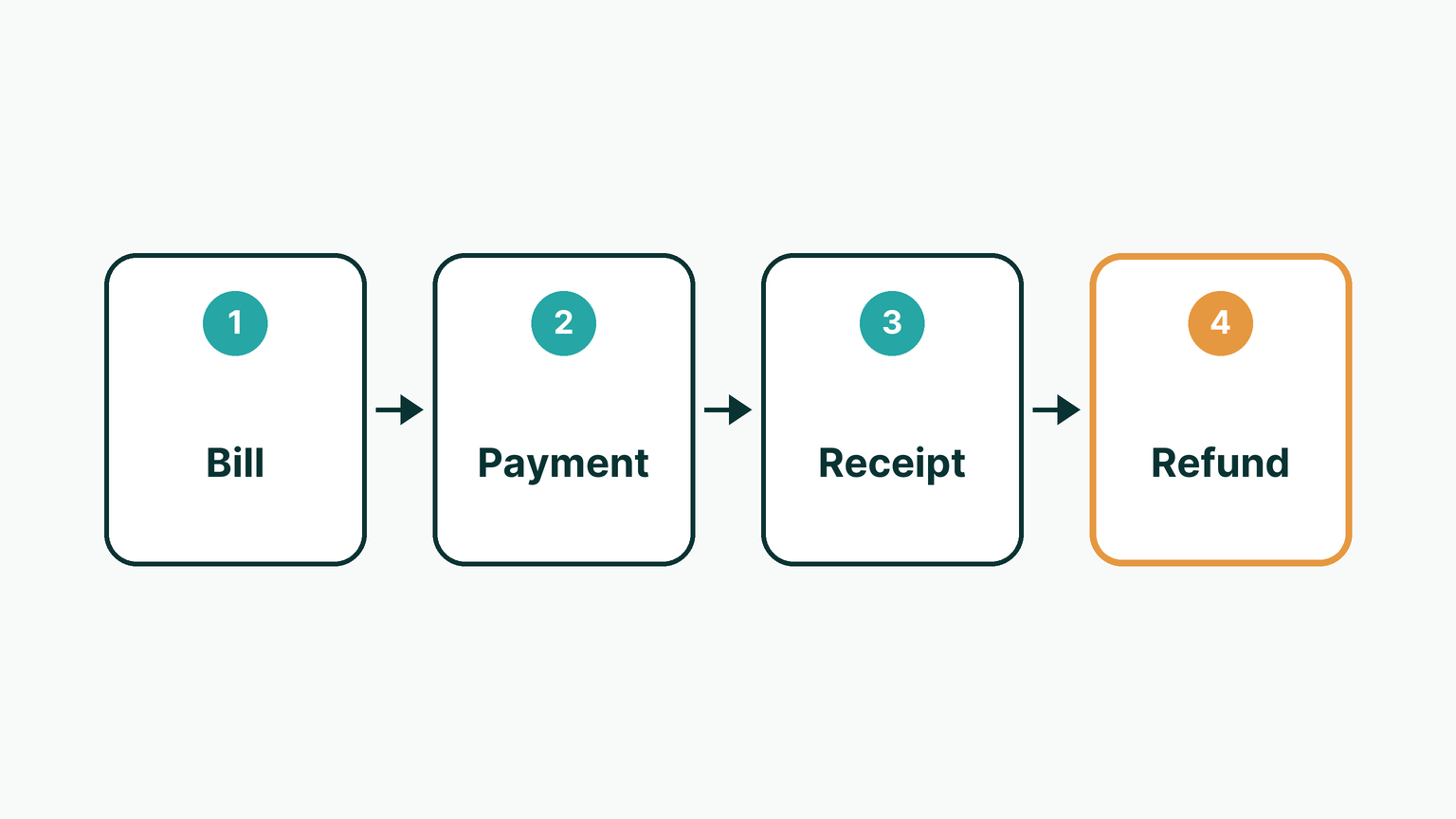
A bill and a receipt are different documents, so they need separate numbered series. Bill and receipt numbering gives an auditor a trail to follow. A gap or a repeated number invites questions that the hospital then has to answer.
GST law points the same way. Section 31 of the CGST Act has a registered person who supplies exempt services issue a bill of supply. Rule 49 gives that bill a consecutive serial number, unique for a financial year. Ask your accountant whether this applies to your hospital's services.
The National Medical Commission's Code of Medical Ethics Regulations, 2002 adds one more detail. It asks a doctor to display their registration number on money receipts given to patients, so the receipt layout should leave room for it.
In MediFlow, bills and receipts are separate numbered series. A correction is a new numbered document, not an edit. This matters because a printed bill that can be edited cannot show what the patient was first given.
We do not promise that a number can never be lost in any situation. When you test any vendor, ask what happens to the number when a save fails halfway. A clear answer is a good sign.
How should a hospital refund process work?
A refund should be a record against the visit, not a correction to the original bill. Then the original receipt and a separate refund note both survive. That pair is what an audit needs, because it shows what was paid and what was returned.
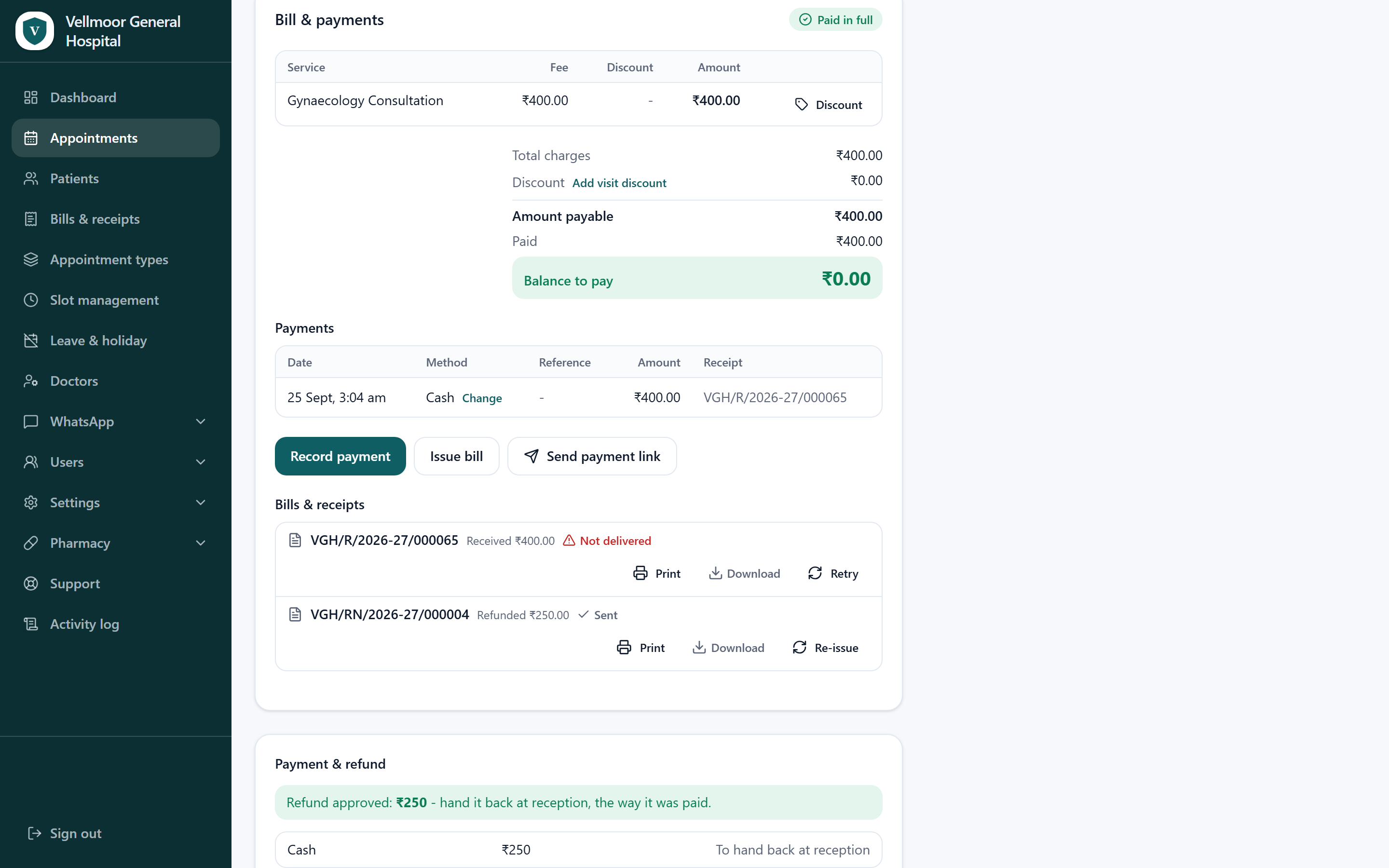
In MediFlow, the person at the desk enters a partial refund amount. So what was withheld is a decision that someone made and can explain. The refund note says how to return the money, the way it was paid. For example, when cash came in, the note says cash goes back at reception.
Refunds already taken are subtracted from the day's revenue on the dashboard. The limit is important: MediFlow records what happened. It does not decide who gets a refund. Your hospital's policy and the person at the desk decide that.
How does the dashboard help at the end of the day?
The dashboard counts cash, UPI, card and online payments separately. That lets the cashier reconcile the drawer at closing. The cash line should match the cash in the drawer. The card line should match the card slips. The UPI line should match the UPI statement.
This suits a hospital with one drawer and a hospital with several. It also suits an owner who wants to see the day without reading each bill.
The limit is that a person still counts the cash. The screen shows the expected figure, and a mismatch is a question for the cashier, not an answer.
What should you check before you buy?
Use this table in a demonstration. Ask the vendor to show each row on screen, with a real visit, not a slide.
| Check | What good looks like | Warning sign |
|---|---|---|
| Where the payment lives | Inside the patient's appointment | A separate system joined by hand |
| Split payment | Each method entered separately, with its own reference | One total typed with a note such as "part cash" |
| Receipt for a split bill | One receipt that lists each method | Several slips for one bill |
| Numbering | Separate numbered series for bills and receipts | Numbers typed by hand or reused |
| Corrections | A new numbered document | Editing a printed bill |
| Refund record | Its own note, with the original receipt kept | The original bill overwritten |
| Partial refund | An amount entered by a person who can explain it | A fixed rule applied silently |
| End of day | Cash, UPI, card and online counted separately | One combined total |
What are the limits of this approach?
Fordawn does not hold your hospital's money. Payment collection depends on your hospital's own payment arrangements, so a payment link works only as far as your bank or payment provider allows.
MediFlow records what happened. It does not decide who gets a refund, and it does not replace the judgement of the person at the desk. Your accountant should confirm how your hospital books these entries.
If your hospital needs something this article does not describe, tell us, and we will say plainly whether MediFlow fits.
How to start
- Ask the vendor to enter a split payment live: part cash, part card, part UPI, each with a reference.
- Watch a partial refund from start to finish, and check that the original receipt and the refund note both remain.
- Look at the numbering of bills and receipts, and ask what happens when a correction is needed.
- Compare the end-of-day dashboard with a drawer count from a real day.
- Read about MediFlow and the work we did on it before you decide.
One last thing
If you would like to see a split payment and a refund on screen, contact us. The first call and the scoping are at no charge.
Questions
What should hospital billing software in India record for a split payment?
Each method entered separately with its own reference, such as the card slip reference or the UPI reference, and one receipt listing them all. The balance should update as methods are added.
Why record payments inside the appointment?
The money and the visit then form one record. Nobody has to join a separate billing system to the visit by hand when a question comes up.
Can a hospital send a payment link for a bill?
MediFlow lists an online payment link among its payment methods. Collection depends on the hospital's own payment arrangements, and Fordawn does not hold the hospital's money.
Why should bills and receipts have separate numbers?
A bill and a receipt are different documents. Separate numbered series let an auditor follow each one, and a correction becomes a new numbered document, not an edit.
How should a hospital refund process keep records?
As a record against the visit. The original receipt and a separate refund note both survive, which shows what was paid and what was returned.
Who decides the amount of a partial refund in MediFlow?
The person at the desk enters it. What was withheld is then a decision someone made and can explain. MediFlow records the result and does not decide who gets a refund.
Can UPI be collected after the visit?
In MediFlow, UPI payments can be collected at booking or after the visit, and the invoice is delivered into the same WhatsApp chat. A patient may still pay cash at the desk.
Sources
Keep reading
- Custom Ecommerce Development: Ask Your Store a Plain Question About Orders and Stock
A store owner who can ask his own store a question in plain words saves a trip through reports. Here is what the 5Senses client can ask about orders, sales and stock, and how the connection stays read-only.
- Freshdesk Microsoft Teams Ticket Bot: Raise a Ticket in Chat
A bot in Microsoft Teams can turn a message into a Freshdesk ticket when someone mentions it. It files the ticket under the real requester, replies with the number and link, and keeps the source thread.
- Node.js Security Vulnerability: How to Protect Your Website
Node.js fixed ten security vulnerabilities on 21 October 2026. Here is what the Node.js security vulnerability means for your website or app, and three questions to ask your developer to stay protected.